Minneapolis-based Target cut its full-year forecast and reported slumping profits and flat comparable sales growth of 0.2 percent over last year, lower than Wall Street analysts expected. Shares of Target dropped almost 22 percent by midday Wednesday.
The company reduced its annual earnings forecast by about 8 percent even as it heads into the busiest shopping season of the year. Target thrives on shoppers making impulse purchases in discretionary categories such as home, apparel and sporting goods, but the company warned consumers are still feeling pressure on their wallets and are seeking out sales and value.
“The current consumer mood is one that is not aligned in Target’s favor,” Neil Saunders, a managing director of GlobalData, said in an analyst note.
Target’s news also comes on the heels of glowing quarterly results from its fiercest competitor. While Walmart has edged out Target over the past few years thanks to its lower prices, its recent quarterly results showed a stark shift in priorities for consumers of all income levels. The Bentonville, Arkansas-based retailer, which raised its full-year outlook Tuesday, noted shoppers from households earning more than $100,000 made up 75 percent of its market share gains in the third quarter. Walmart said it was seeing positive results in its discretionary categories, suggesting that consumers who may have once browsed those aisles at Target are now trading-down at Walmart.
Walmart also has an edge over Target in the grocery category as consumers battle high grocery prices. In addition to Target having a more limited selection at most stores than Walmart, it also can’t compete on price. The company announced in May that it was lowering prices on 5,000 items, including food and household staples. Target said Wednesday that by the end of the year, it will have cut prices on over 10,000 items.
Same-store sales for Target fell 1.9 percent in the third quarter compared to the same period last year. Total revenue was $25.7 billion, about 1.1 percent higher than 2023, and total sales increased just 0.9 percent. Target chief executive Brian Cornell said Wednesday that the results show that consumers are “shopping carefully as they work to overcome the cumulative impact of multiple years of price inflation.”
Target chief commercial officer Rick Gomez said in an earnings call Wednesday that consumers have become more “resourceful” and deals-focused. For example, Gomez said, sales dipped leading up to the Target Circle week in October that starts the retailer’s holiday shopping push and fell again after.
Some of Wall Street’s major stock indexes remain below their all-time highs, which means bargains can still be found.
Most online brokerages have done away with commission fees and minimum-deposit requirements, making it easier than ever for retail investors to put their money to work.
Three time-tested companies possess the necessary growth catalysts to make patient investors notably richer.
You don’t need a mountain of cash to build wealth on Wall Street.
Investing on Wall Street can sometimes be a roller coaster of emotions. The COVID-19 crash in February-March 2020 was the quickest bear market decline in history. Meanwhile, the rallies growth-stock investors have enjoyed in 2021 and 2023 have been jaw-dropping.
Despite these notable gains, some of Wall Street’s most followed indexes (e.g., the Nasdaq Composite) remain below their all-time closing highs. Put another way, high-quality stocks can still be purchased at a discount if you’re willing to put in the work and look for bargains.
What’s particularly noteworthy about putting your money to work on Wall Street is that prior barriers to investment have been all but torn down. Most online brokerages have completely done away with minimum-deposit requirements and commission fees for common stock trades executed on major U.S. exchanges. In other words, any amount of money — even $500 — can be the ideal amount to put to work.
If you have $500 that’s ready to invest, and this isn’t cash that’ll be needed to pay bills or cover an emergency, the following three stocks stand out as no-brainer buys right now.
Visa
The first genius stock you can confidently add to your portfolio with $500 is world-leading payment processor Visa(V). Even though Visa shares are near an all-time high, the company sports a laundry list of competitive advantages that should continue to lift its valuation for years, if not decades, to come.
The interesting thing about Visa is that its biggest headwind is also its greatest opportunity. Like most financial stocks, Visa is cyclical. This is to say that its operating performance tends to ebb and flow with the health of the U.S. and global economy. If a recession takes place, consumer and enterprise spending would be expected to decline, leading to weaker fee collection for Visa.
However, the “ebbs” don’t last nearly as long as the “flows.” Only three of the 12 U.S. recessions since World War II have lasted at least one year. By comparison, most periods of expansion last multiple years, with two expansions lasting a full decade. Visa is perfectly positioned to take advantage of these extended periods of growth.
To add to the above point, Visa’s growth runway during these long-winded expansions is enormous. As of 2021, it held a nearly 53% share of credit card network-purchase volume in the United States. Meanwhile, faster-growing emerging-market regions, including the Middle East, Africa, and Southeastern Asia, remain largely underbanked and therefore ripe for disruption by financial-services providers like Visa.
Something else that’s been critical to Visa’s long-term success is its avoidance of lending. Visa is a well-known and trusted brand, and it would likely succeed as a lender. But doing so would also expose the company to credit delinquencies and loan losses during inevitable economic slowdowns. Completely avoiding the lending arena means not having to set aside capital for potential losses. It’s one of the key reasons Visa bounces back from recessions so quickly.
Lastly, Visa is a cash cow with a profit margin north of 50%. Although its forward price-to-earnings (P/E) ratio of 23 is higher than the benchmark S&P 500, Visa’s expected annualized earnings-growth rate of 14% over the next five years makes its stock a bargain.
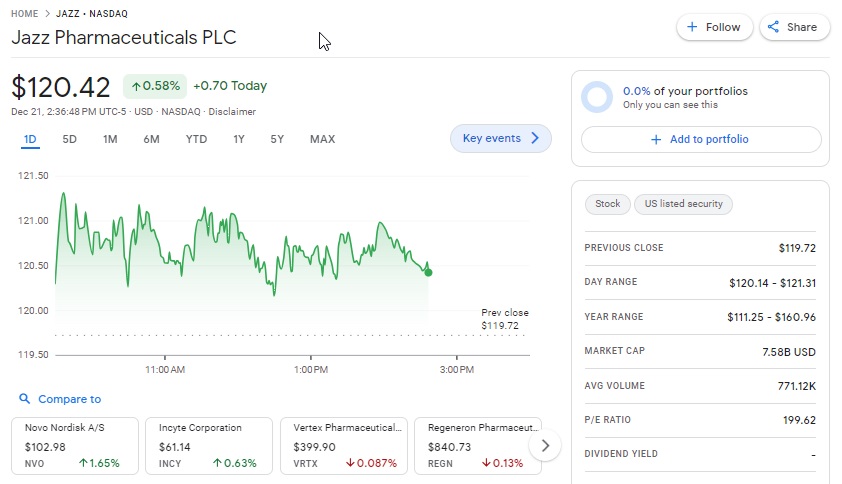
Jazz Pharmaceuticals
A second no-brainer stock with an exceptionally favorable risk-versus-reward profile for patient investors is specialty healthcare companyJazz Pharmaceuticals(JAZZ).
The enemy of pretty much every drug developer is time. Novel therapies have finite periods of sales exclusivity. Once those periods of exclusivity end, it’s not uncommon for generic drugs and/or biosimilar competition to enter the space and either siphon away sales or reduce the average selling price for a product. Jazz generates about half of its revenue from its oxybate franchise (Xywav and Xyrem), which help patients with various sleep disorders. A high concentration of sales in one franchise/area of focus can be worrisome.
However, Jazz Pharmaceuticals has its bases covered. The company developed a next-generation version of its narcolepsy blockbuster Xyrem. This new version, known as Xywav, contains 92% less sodium than its predecessor. Not only does this make Jazz’s drug safer to take for patients with higher cardiovascular risk factors, but it’ll help preserve the company’s cash flow and sales exclusivity for many years to come.
Jazz’s oncology portfolio is also gaining momentum. Cancer-drug sales look to be on track to reach $1 billion in 2023, with acute lymphoblastic leukemia therapy Rylaze doing a lot of the heavy lifting with sales up 46% year to date to $292.5 million.
Cannabidiol-based drug Epidiolex is holding its own as well. Since Jazz acquired GW Pharmaceuticals in May 2021 to get its hands on Epidiolex, sales have continued to grow. Additional worldwide approvals, along with label-expansion opportunities, have the ability to eventually push Epidiolex’s annual sales past $1 billion.
Don’t overlook Jazz’s pipeline, either. The company anticipates as many as five late-stage trial readouts before the end of 2024, with many of these advanced studies focused on experimental cancer drugs.
The third no-brainer stock to buy with $500 right now, conglomerate Berkshire Hathaway(BRK.A) (BRK.B), may not be a household name, but its billionaire CEO, Warren Buffett, certainly is. Take note, I’m specifically talking about Berkshire’s Class B shares (BRK.B), since a single Class A share will set an investor back more than $544,000!
Since the Oracle of Omaha became CEO in 1965, he’s overseen a 19.8% annualized return in his company’s Class A shares (BRK.A). The Class B shares weren’t issued until 1996, which is why I’m referring to returns of the Class A shares in this instance. Even if Berkshire fails to return close to 20% on an annualized basis moving forward, Buffett and his team have clearly demonstrated their ability to outpace the broader market over long periods.
One of the factors that makes Berkshire Hathaway such a special investment, other than Warren Buffett, is its focus on cyclical businesses.
Buffett and the late Charlie Munger, who served as Berkshire’s vice chairman for 45 years, realized a long time ago that betting on the U.S. economy to grow over time is a smart idea. Instead of trying to guess when recessions would occur, Buffett and Munger packed Berkshire’s investment portfolio and owned assets with time-tested, profitable, cyclical businesses. Thanks to extended periods of economic expansion, these long-term holdings have delivered big gains for Berkshire and its shareholders.
Another unsung hero for Berkshire Hathaway is the myriad of dividend stocks that sit in its investment portfolio. Over the course of the next year, Buffett and his investing aides will oversee the collection of around $6 billion in dividend income. On top of being recurringly profitable, dividend stocks have historically run circles around publicly traded companies that don’t offer a payout.
Furthermore, the culture that Charlie Munger instilled at Berkshire Hathaway is going to live on for decades to come. While every investor would love to see Warren Buffett live to be 120, the truth is that he and Munger built Berkshire Hathaway to succeed long after they’re gone. If the American economy is growing over time, there’s a good chance Berkshire’s wholly owned subsidiaries, which include insurer GEICO and railroad BNSF, as well as the company’s $374 billion investment portfolio, are going to benefit.
Should you invest $1,000 in Visa right now?
Before you buy stock in Visa, consider this:
The Motley Fool Stock Advisor analyst team just identified what they believe are the 10 best stocks for investors to buy now… and Visa wasn’t one of them. The 10 stocks that made the cut could produce monster returns in the coming years.
Consider when Nvidia made this list on April 15, 2005… if you invested $1,000 at the time of our recommendation, you’d have $294,765!*
Stock Advisor provides investors with an easy-to-follow blueprint for success, including guidance on building a portfolio, regular updates from analysts, and two new stock picks each month. The Stock Advisor service has nearly quadrupled the return of S&P 500 since 2002*.
With a net worth of $250 billion, Elon Musk is officially the wealthiest person on earth.
And with an IQ of 155, he’s also one of the smartest.
However, by openly advocating for a type of energy that the U.S. military says could have a “significant impact on the army, our allies, the international community, the commercial power industry, and the nation…”
And even though you may not know it, or even care…
The coming war on Elon Musk is going to have a direct impact on you, your family, and your financial investments in the years to come.
In this new exposé, you’ll learn what it is that Elon has discovered, and how you can profit from it in the months and years to come. Check it out here…
It was the best half-year for billionaires since the back half of 2020, when the economy rebounded from a Covid-induced slump.
The gains coincided with a broad stock market rally, as investors brushed off the effects of central bank interest rate hikes, the ongoing war in Ukraine and a crisis in regional banks. The S&P 500 rose 16% and the Nasdaq 100 surged 39% for its best-ever first half as investor mania over artificial intelligence boosted tech stocks. Here’s a link to this article.





 SVENFLY