Why durability research is accelerating — and which materials are proving most effective.
Modern construction is undergoing a major shift. Because climate conditions are becoming more extreme and unpredictable, researchers and builders are focusing on materials that can withstand storms, heat, flooding, wildfires, and long‑term environmental stress. This applies not only to new buildings, but also to retrofitting older structures so they remain safe and functional.
The studies highlighted in your search results show a clear trend: durability now means climate resilience.
Why Climate‑Resistant Materials Are Needed
According to recent analyses:
Climate change is increasing storm intensity, including hurricanes, tornadoes, and heavy rainfall.
Rising temperatures and heat waves are stressing building envelopes and HVAC systems.
Flooding and sea‑level rise require water‑resistant foundations and materials.
Wildfires demand fire‑resistant exterior materials and assemblies.
Storms are becoming more severe and frequent, requiring stronger, sustainable materials.
Extreme weather causes structural damage, water intrusion, roof failures, and window breakage.
This is why so many studies now focus on materials that can resist wind, water, heat, fire, and impact.
Key Materials Improving Durability in Modern Construction
Below is a synthesis of the most climate‑resilient materials identified across the research.
1. Insulated Concrete Forms (ICFs)
Combines concrete with rigid foam insulation.
Highly resistant to wind, fire, flooding, and temperature extremes.
Provides superior thermal performance and structural strength.
Highlighted as one of the most durable materials for climate‑resilient homes.
Many studies are taken place to best improve the durability of modernized old and new construction commercial and residential buildings. These studies include materials necessary to resist varying catastrophic and harsh climate conditions.
1. Structural Materials
These form the backbone of any building—whether a home, office, or industrial facility.
Concrete
Most widely used material for foundations, slabs, columns, beams, and floors.
Strong, durable, moldable, and cost-effective.
Made from cement, water, sand, and aggregates.
Source: Concrete is consistently listed as the top essential material.
Steel
Used for reinforcement (rebar), framing, beams, and large-span structures.
High tensile strength and flexibility—critical for commercial buildings.
Source: Steel is highlighted as a key structural material.
Wood
Common in residential framing, flooring, roofing, and interior finishes.
Renewable, lightweight, and naturally insulating.
Source: Wood is a core material for residential and light commercial builds.
Bricks & Blocks
Used for walls, partitions, facades, and load-bearing structures.
Fire-resistant and thermally efficient.
Includes clay bricks, concrete blocks, and formwork blocks.
Source: Concrete blocks and formwork blocks are essential items in modern construction lists.
2. Foundation & Earthwork Materials
Aggregates (Sand, Gravel, Crushed Stone)
Used in concrete mixes, mortar, drainage layers, and site leveling.
Also used directly as underlays for slabs and landscaping.
Source: Aggregates are essential for forming, filling, and shaping.
Cement & Binders
Cement acts as the binder in concrete and mortar.
Other binders include natural resins and lime.
Source: Binders are listed as core construction materials.
3. Exterior Envelope Materials
These materials protect the building from weather and define its appearance.
Glass
Used for windows, facades, skylights, and storefronts.
Modern glass options include tempered, laminated, insulated, and low‑E.
Source: Glass is indispensable for light-filled buildings.
Siding & Cladding Materials
Options include vinyl, fiber cement, metal panels, stone veneer, and brick veneer.
Chosen for durability, insulation, and aesthetics.
Copper alloys are among the most durable, reliable, and high‑performance materials used in mechanical, electrical, and plumbing (MEP) systems. The research you surfaced highlights several reasons why copper alloys remain the gold standard for pipes, wiring, and HVAC components.
Below is a structured explanation grounded in the sources you triggered.
1. Exceptional Electrical & Thermal Conductivity
Copper and its alloys have industry‑leading conductivity, which is why they dominate electrical wiring and HVAC heat‑exchange components.
Copper’s electrical and thermal conductivity is highlighted as one of its defining advantages.
High conductivity means:
Less energy loss in wiring
More efficient heat transfer in HVAC coils
Better performance under load
This is why copper remains the preferred material for electrical wiring, busbars, and HVAC coils.
2. High Corrosion Resistance
Copper alloys resist corrosion extremely well—even in harsh environments.
The Copper Development Association notes that copper alloys have strong resistance to corrosion and stress corrosion cracking.
This makes them ideal for:
Plumbing pipes
HVAC coils
Outdoor mechanical systems
Marine or coastal installations
Copper alloys form a protective oxide layer that prevents long‑term degradation.
3. Fire Resistance & High‑Temperature Stability
Copper alloys maintain strength and conductivity even at elevated temperatures.
Research shows copper alloys retain mechanical and electrical properties under thermal stress.
This makes them safer and more reliable for:
Electrical wiring
Fire‑rated systems
High‑temperature HVAC components
Unlike plastics, copper does not melt, burn, or release toxic fumes.
4. Mechanical Strength & Durability
Copper alloys offer a strong balance of strength, ductility, and formability.
Tensile and mechanical properties are well‑documented across hundreds of copper‑based alloys.
This allows copper alloys to:
Withstand pressure in plumbing systems
Resist vibration and fatigue in HVAC systems
Maintain structural integrity over decades
This is why copper pipes often last 50–100 years in buildings.
5. Antimicrobial Properties (Bonus Advantage)
Copper has natural antimicrobial behavior.
The Copper Development Association highlights copper’s intrinsic antimicrobial properties and EPA‑validated performance.
This is especially beneficial in:
Hospitals
Schools
High‑touch mechanical systems
While not the primary reason for MEP use, it’s a valuable added benefit.
6. Sustainability & Recyclability
Copper alloys are 100% recyclable without losing performance.
Sustainability and recyclability are emphasized in modern copper alloy research.
This supports:
LEED certification
Circular construction practices
Long‑term material efficiency
Copper is one of the most recycled metals in the world.
Summary Table: Why Copper Alloys Excel in MEP Systems
Non-combustible; high melting point; no toxic fumes
Safer electrical systems, compliance with fire codes
Compatibility
Works well with standard fittings, solders, and joining methods
Predictable performance and easier system integration
Longevity
Proven multi-decade lifespan in real-world installations
Lower lifecycle cost and fewer replacements
Sustainability
100% recyclable without performance loss
Supports green building goals and material circularity
Bottom Line:
Copper alloys are extremely effective for MEP systems because they combine:
High conductivity
Corrosion resistance
Mechanical durability
Fire safety
Long service life
Sustainability
This makes them one of the most reliable materials for pipes, wiring, and HVAC components in both commercial and residential buildings.
In certain locations the readiness of raw materials is industrialized and incorporated within the budget for building adequate buildings reducing on-site maintenance costs. The production of these materials creates more jobs for builders, exploiting expansions of industrial plaza, residential areas and shopping plazas keeping communities engaged within those areas.
Major projects accommodating education, transportation, and Community centers pursuits in these locations.
Copper is one of the most studied and widely used metals in engineering, construction, and MEP systems. Its properties make it indispensable for electrical wiring, plumbing, HVAC components, and architectural applications.
1. Physical Properties of Copper
Copper’s physical characteristics are what make it so valuable in electrical, thermal, and architectural applications.
Key Physical Properties
Distinctive reddish‑orange metallic luster
Excellent electrical conductivity (second only to silver among pure metals)
High thermal conductivity — ideal for heat exchangers and HVAC coils
Very ductile and malleable — easily drawn into wires or hammered into sheets
Moderate melting point:
(1357.77 K)
Boiling point:
(2835 K)
Density:
8.96 g/cm³
Corrosion resistance — forms a protective oxide layer in air
2. Mechanical Properties of Copper
Copper’s mechanical behavior makes it ideal for piping, wiring, and mechanical components.
Key Mechanical Properties
High ductility — can be stretched into thin wires without breaking
High malleability — can be shaped or rolled easily
Good tensile strength (varies by alloy and temper)
Tensile properties are detailed in engineering guides for copper alloys
Excellent formability — suitable for extrusion, forging, and cold forming
Good fatigue resistance — important for HVAC vibration environments
Work‑hardening capability — copper strengthens when mechanically deformed
3. Chemical Properties of Copper
Copper’s chemical behavior is central to its corrosion resistance and antimicrobial performance.
Key Chemical Properties
Common oxidation states: +1 and +2
Reacts with oxygen to form:
Copper(I) oxide (Cu₂O)
Copper(II) oxide (CuO)
Does not react with water, but slowly reacts with atmospheric oxygen to form a protective layer
Forms green patina (copper carbonate) over time in moist air
High corrosion resistance due to stable oxide films
Acts as a catalyst in many chemical reactions
Intrinsic antimicrobial behavior — scientifically validated and documented in copper alloy research
Summary Table:
Property Type
Key Characteristics
Sources
Physical
High electrical thermal conductivity, ductile, malleable, corrosion‑resistant, moderate melting point
Copper mineral
Mechanical
Strong, formable, ductile, good tensile strength, work‑hardening
Copper Alloys
Chemical
Oxidation states +1/+2, forms oxides, corrosion‑resistant, catalytic, antimicrobial
Copper Catalysts
Here are The Scientific Evidence That Copper Has Intrinsic Antimicrobial Properties
Modern research overwhelmingly confirms that copper and its alloys naturally kill bacteria, viruses, and fungi without needing chemicals or coatings. This antimicrobial action is intrinsic—it comes from the metal itself.
Below are the key scientific findings supported by peer‑reviewed studies and authoritative reviews.
1. Copper Generates Reactive Oxygen Species (ROS)
Extensive research shows that copper ions trigger the formation of reactive oxygen species, which damage microbial cells.
Copper’s antimicrobial mechanism is “multifaceted,” with ROS generation being the main bactericidal mechanism, causing irreversible membrane damage.
ROS attack lipids, proteins, and DNA, leading to rapid cell death.
Why this matters: ROS generation is a built‑in chemical property of copper—this is one of the strongest proofs that its antimicrobial activity is intrinsic.
2. Copper Ions Disrupt Cell Membranes
Copper ions penetrate and destabilize microbial membranes.
Copper complexes “disrupt microbial membranes” and compromise membrane integrity.
This leads to leakage of essential nutrients and rapid cell collapse.
Why this matters: Membrane disruption is a universal antimicrobial mechanism effective against bacteria, fungi, and viruses.
3. Copper Causes DNA and RNA Damage
Copper ions bind to and degrade genetic material.
Copper complexes interact with DNA and proteins, causing DNA cleavage and enzyme inhibition.
Copper ions released from surfaces lead to RNA degradation in viruses.
Why this matters: This explains why copper kills even antibiotic‑resistant bacteria and enveloped viruses.
4. Copper Destroys a Wide Range of Microorganisms
Historical and modern studies show copper kills bacteria, fungi, and viruses at extremely low concentrations.
Copper inhibits numerous microbes including Bacillus, Candida, Aspergillus, and others, even at low concentrations.
Some organisms are completely inhibited at concentrations as low as 0.04 g/L.
Why this matters: This broad‑spectrum activity is rare and demonstrates copper’s intrinsic toxicity to microbes.
5. Copper Alloy Surfaces Kill Pathogens on Contact
Scientists have repeatedly demonstrated that copper alloy “touch surfaces” destroy harmful microorganisms.
Research confirms the intrinsic efficacy of copper alloy surfaces in killing a wide range of pathogens that threaten public health.
Why this matters: This is why copper is used in hospitals, transit systems, and high‑touch public environments.
6. The Oligodynamic Effect
Copper ions exhibit the “oligodynamic effect”—a toxic effect on microbes even at very low concentrations.
The oligodynamic effect was identified in 1893 and applies to copper ions, which kill bacteria, fungi, spores, and viruses at low doses.
Why this matters: This effect is a fundamental chemical property of copper, not a surface treatment.
Summary: What Science Have Proven
Across multiple independent studies:
Copper releases ions that damage membranes, DNA, and RNA.
Copper generates ROS that kill microbes.
Copper surfaces continuously kill bacteria and viruses.
Copper works at extremely low concentrations (oligodynamic effect).
Tensile strength ~275–380 MPa; good weldability; good toughness
Outstanding resistance to seawater corrosion and biofouling
70/30 Copper‑Nickel
C71500
70% Cu, 30% Ni
Lower conductivity; very high corrosion resistance
Tensile strength ~350–500 MPa; high strength; good fatigue resistance
Superior resistance to erosion, stress corrosion, and seawater
Brief Summary of Copper and Its Alloys
Copper and its alloys stand out as some of the most reliable and durable engineering materials used in modern construction and MEP systems. Their exceptional mechanical strength, corrosion resistance, and long service life make them ideal for demanding environments ranging from residential plumbing to large‑scale commercial HVAC and electrical infrastructure. Copper’s excellent formability allows it to be drawn, rolled, extruded, or shaped into complex components without losing structural integrity, supporting efficient manufacturing and installation.
Beyond performance, copper is inherently sustainable. It is 100% recyclable without any loss of properties, enabling a fully circular material lifecycle that reduces environmental impact. Its intrinsic antimicrobial behavior—a natural ability to deactivate bacteria, viruses, and fungi—adds a unique health and safety advantage, especially in high‑touch or high‑traffic environments.
Copper alloys such as brasses, bronzes, and copper‑nickels expand this versatility even further. By adjusting alloying elements like zinc, tin, aluminum, or nickel, engineers can tailor strength, corrosion resistance, conductivity, and wear performance to meet specialized requirements. This combination of reliability, durability, sustainability, formability, and intrinsic functional benefits is why copper and its alloys remain foundational materials across the built environment.
During autumn months most of leaves on trees turn to red, yellow, orange, brown and pale green colors due to the cold weather. The temperature in these regions gets cold and harvesting, canning, crafts and sales takes place. On some occasions, storage of goods can be costly driving up liquidation.
Most parks and trails are packed with campers, others come during the day just to enjoy nature walks and picnics playing games, having marshmallows’ smores, telling folktales and gathering around campfires in the evenings and nights.
The fallen leaves create openings inviting distance scenes with attractive colors spreading and creating dramatic sceneries. As the fallen leaves’ scatters, they reveal glimpses of distance landscapes, where vibrant colors tend into breathtaking scenes.
With these fallen leaves, emerging distance places framed by stitches of autumn hues, paints dramatic sceneries. The shedding trees open windows to faraway views where brilliant colors ripple across the land in spectacle of seasonal drama.
It’s always necessary to eat together as a family. During mealtime, coming together and having a common meal gives everyone a chance to have open interactions and discussions about the meal and whatever is going on around us and globally.
Discussions during family meals can be broadly categorized into catching up on the day, sharing stories, discussing opinions and planning for the future.
The topics range from daily events, schoolwork, and current events to personal memories and future plans, creating an opportunity for communication, bonding, and family connection.
Daily life and activities recapping the day:
Each member shares highlights or challenges from their day.
School and Work:
Discussing upcoming tests, homework, or professional projects.
Extracurricular Projects:
Talking about sports, clubs, or other activities.
Personal experiences and stories.
Sharing Memories:
Remembering about funny, happy or significant family stories from the past.
Ancestral History:
Sharing stories about where your ancestors originated.
Personal Interests:
Discussing hobbies, books, or new things learned online.
Opinions and Perspectives
Current Events:
Discussing age-appropriate activities and news or interesting topics from the world.
Thought-Provoking Questions:
Posing questions to encourage different perspectives and opinions.
Family Values:
Transmitting family values and beliefs through conversations.
Future plans and coordination for Upcoming events:
Discussing upcoming holidays, family events or weekend plans.
Coordination:
Confirming schedules and who is responsible for what.
Future Goals:
Talking about personal or family goals for the coming week or year.
Relationship building Asking Questions:
Parents can ask questions to learn more about their children.
Laughter and inside jokes:
Keeping the atmosphere light and fun with jokes and pleasantries.
Eating Together Matters:
Eating dinner with family provides time for conversation.
Parents can teach healthy communication skills without distractions from smartphones.
Here are some practical ways they can foster strong communication habits:
🧠 Strategies for Teaching Healthy Communication
📵 Create Tech-Free Zones Designate times and spaces (like dinner or bedtime) where phones are put away, encouraging face-to-face interaction.
👂 Practice Active Listening Show children how to listen without interrupting, maintain eye contact, and respond thoughtfully. This builds empathy and patience.
🗣️ Model Clear Expression Use “I” statements (“I feel…” instead of “You always…”) to express emotions and needs without blame. Kids learn by example.
🔄 Encourage Turn-Taking In conversations, teach the value of waiting for one’s turn to speak. This helps children respect others’ voices.
📚 Use Storytelling and Role Play Create scenarios where kids practice resolving conflicts, expressing gratitude, or asking for help — all without screens.
💬 Reflect and Reframe After disagreements, guide children to reflect on what was said and how it could be phrased more constructively.
🎯 Set Boundaries Around Tech Explain why limiting screen time matters for relationships. Involve kids in setting family rules around device use.
5 Benefits of Eating Together as a Family – Making time for family meals is worth the effort.
Sitting together and sharing a meal provides families with an opportunity to bond, improve their nutrition, better academic performance, healthier habits, and emotional well-being.
1. Stronger Family Bonds
Sharing meals fosters connection. It’s a chance to talk, laugh, and check in with each other — building trust and emotional closeness.
2. Improved Nutrition
Families who eat together tend to consume more fruits, vegetables, and balanced meals. Home-cooked food often means fewer processed ingredients and better portion control.
3. Better Academic Performance
Children who regularly eat with their families often show improved vocabulary, reading skills, and school performance — thanks to richer conversations at the table.
4. Healthier Habits
Family meals help establish routines, reduce risky behaviors in teens, and promote mindful eating. Kids learn by watching adults make healthy choices.
5. Emotional Well-being
Eating together provides a sense of stability and belonging. It can reduce stress, anxiety, and feelings of isolation — especially during busy or challenging times.
Dinnertime is a time of respite despite the hustie-bustie of everyday life.
🍽️ Dinnertime: A Daily Respite
In the hustle and bustle of everyday life, dinnertime offers a rare pause — a moment to reconnect, reflect, and recharge. It’s not just about food; it’s about presence, conversation, and the comfort of shared routine.
Family can review the day’s events and plan accordingly for future days.
The science behind family Dinners – It’s not just about family meals, is that they bring so many good things that’s have nothing to do with the meal.
The significance of Eating Together as a Family – Decide to Commit:
“I believe that sitting around the table with the family can make a significant difference in physical health, psychological status and can strengthen family bonds.”
This simple act — gathering for a meal — nurtures more than just the body. It fosters connection, stability, and shared values in a world that often pulls us in different directions.
In a world of packed schedules and digital distractions, making time for shared meals is a conscious choice — and a powerful one. Here’s why that commitment matters:
💬 Builds Communication Rituals Regular meals create space for open dialogue, storytelling, and emotional check-ins — habits that strengthen family bonds.
🧠 Supports Mental and Emotional Health The predictability of shared meals offers comfort and stability, especially for children navigating stress or change.
🥗 Encourages Healthier Eating Families who eat together tend to make more nutritious choices, fostering lifelong habits around balanced meals and portion awareness.
📆 Reinforces Routine and Responsibility Committing to mealtime teaches time management, shared responsibility (like setting the table or helping cook), and respect for others’ schedules.
🌱 Models Values and Culture Mealtime becomes a space to pass down traditions, express gratitude, and reinforce family values — whether through prayer, conversation, or shared dishes.
🧾 Conclusions: The Power of Eating Together as a Family
Intentional Commitment Matters Choosing to prioritize shared meals is a conscious act that strengthens family bonds and nurtures emotional well-being.
Mealtime Builds Communication Sitting together fosters open dialogue, active listening, and deeper understanding — essential for healthy relationships.
Physical and Mental Health Benefits Families who eat together tend to enjoy better nutrition, reduced stress, and greater emotional stability.
Cultural and Value Transmission Shared meals are a space to pass down traditions, reinforce values, and celebrate identity through food and conversation.
Respite in a Busy World Amid the hustle and bustle, dinnertime offers a moment of pause — a daily ritual that grounds families in connection and care.
🧠 Psychological Conclusions of Family Mealtime
Emotional Security Regular family meals create a predictable routine that fosters a sense of safety and belonging — especially important for children and adolescents navigating emotional development.
Reduced Risk of Mental Health Issues Studies show that teens who eat with their families are less likely to experience depression, anxiety, and substance abuse. The consistent social support acts as a buffer against stress.
Improved Self-Esteem and Resilience Conversations at the table help children feel heard and valued, which boosts confidence and teaches emotional regulation through modeled behavior.
Social Skill Development Mealtime is a natural setting for learning empathy, turn-taking, and respectful disagreement — all foundational to healthy interpersonal relationships.
Intergenerational Connection Sharing stories, traditions, and values during meals strengthens identity and continuity, which are key to psychological resilience.
The American Pelicans are impressive bird in many ways. Its wingspan is one of the widest of any North American bird. It’s also one of the heaviest flying birds in the world, weighing up to 30 pounds. Pelicans breeds on islands in freshwater lakes, wetlands, and oceans. Forages on fresh or saltwater estuaries, marshes, lakes, or rivers.
SHORT DESCRIPTION:
Scientific Name:Pelecanus erythrorhynchos
Population: 450,000
Trend: Increasing
Habitat: Breeds on islands in freshwater lakes, wetlands, and oceans. Forages on fresh or saltwater estuaries, marshes, lakes, or rivers.
ABOUT:
The American Pelicans are impressive bird in many ways. Its wingspan is one of the widest of any North American bird. It’s also one of the heaviest flying birds in the world, weighing up to 30 pounds. A flock of these pelicans on the water or soaring high in blue sky creates an impressive sight.
Both sexes of American Pelicans look alike, with snow-white plumage set off by black wing feathers that are most noticeable in flight. Bill, legs and feet are pale orange. Juveniles are dusky white or brown with pale yellow bills and feet.
Like many waterbirds such as the Great Egret, the American Pelicans becomes more colorful during its breeding season, with the bare skin around the eye, legs and feet changing to a vivid red-orange, and a light-yellow crest growing atop its head.
A more unusual feature of this species is the strange-looking “horn” or ridge that grows atop its upper bill during the breeding season.
Titillating Tubercles
The “horn” on the upper bill of an adult American Pelicans are fibrous growth known as the nuptial tubercle. This odd growth develops in both sexes during the breeding season and is thought to contribute to its mating displays and perhaps signal breeding fitness. The nuptial tubercle frays and splits as the season goes on, and eventually sheds off, to regrow the next year.
SONGS and SOUNDS:
The adult American Pelicans are silent species, only giving low, grunting calls, usually heard at colony sites. The young are far noisier – even pelican embryos can emit loud squawks inside the egg in response to overheating or chilling. Groups of young make loud begging calls, raising a clamor that can be heard from a long distance away!
Listen to a variety of American Pelicans sounds here.
Breeding and Feeding
The American Pelican are highly social and seasonally monogamous, pairing up quickly after arriving at their large colony sites, usually located on isolated lake or marsh islands. Courtship consists of circular flights over the colony, often in groups, and a variety of displays on the ground, including strutting, bowing, and head swaying.
A mated pair works to build their nest, a simple scrape on the ground, sometimes edged with a shallow rim of vegetation. Average clutch size is two eggs, and both adults share incubation duties for close to a month, warming the eggs under their large, webbed feet, a behavior that occurs only in pelicans and some pelican-like birds, such as Brown Booby and Brandt’s Cormorant. The young hatch naked and blind, but their eyes open within a day, and they quickly develop coverings of brown/white/black down.
Life in the nest is competitive and dangerous. Older nestlings often kill their younger siblings or push them out of the nest, particularly in times of food scarcity. This seemingly cruel behavior, called siblicide, has a practical purpose: If there is enough food, more chicks survive; if not, only the strongest make it to adulthood. Siblicide occurs in other birds such as the Great Horned Owl, Red-tailed Hawk, and Great Blue Heron.
Both pelican parents feed their young by regurgitating food. After several weeks, hatchlings leave the nest and congregate in large groups, known as pods or crèches. These groups provide protection from predators while parents are away foraging. Young pelicans leave the pod each day to return to the vicinity of their nest, where their parents continue to feed them. The young fledge after 2-3 months and leave the colony soon after.
Dipping for Dinner
Unlike the Brown Pelican, which usually plunge and dives for food, the white Pelicans feeds on or just below the water’s surface. Groups cooperate to drive prey into shallow water for easier capture, then feed in graceful, synchronized dipping maneuvers, sometimes completely encircling their prey while they feed.
Small fish, amphibians, smaller marine life and shrimps are favored food items, but this species is opportunistic and will alter its diet in response to changing water levels or prey abundance. Migrating birds will readily forage at aquaculture farms.
Like the Bald Eagle, the American Pelicans are also a kleptoparasite, stealing food from other birds, including other pelicans and cormorants, when the opportunity presents itself.
REGION and RANGE
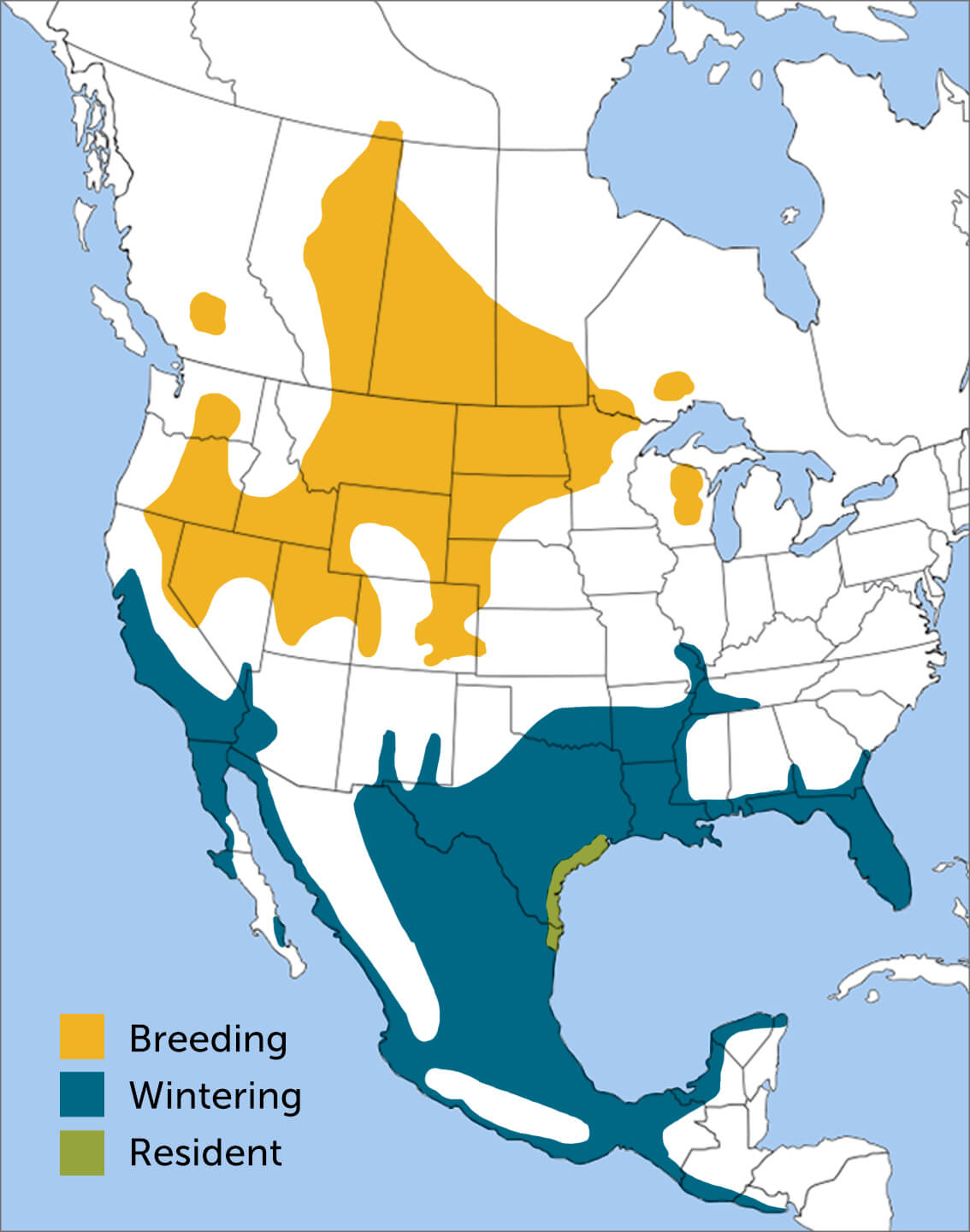
American Pelicans range map
The American Pelicans nests in two fairly distinct populations. The first concentrates west of the Rocky Mountains in British Columbia, California, Nevada, Utah, and Idaho. These birds winter along the Pacific coast, from California south to Nicaragua.
The second population of American Pelicans nests in the Canadian prairie provinces and upper Midwest states, migrating primarily southward and eastward towards the Gulf of Mexico.
American Pelicans are daytime migrants, travelling in V-shaped flocks of up to several hundred birds. Like the Turkey Vulture and Swainson’s Hawk, it takes advantage of energy-saving thermals as it flies. Non-migratory populations are resident in Texas and Mexico.
CONSERVATION:
American White Pelicans populations declined by the mid-twentieth century due to overhunting and chemical pesticides such as DDT. Although these issues have been largely addressed, this species remains vulnerable to habitat loss on its foraging and breeding grounds. They may also be shot as pests at aquaculture farms.
The American White Pelicans especially sensitive to human disturbance and will abandon its eggs and young if a breeding colony is approached too closely.
St. Patrick’s Day is a famous celebration of Irish culture and activities. This celebration takes place in most popular cities nationwide, Europe, Ireland and in other parts of the world. The festivities includes’ parades, fine arts activities, dinning and drinking. Some of the restaurants serves green dish meals and corn beef hotpot casserole which is one of the most favorite.
A shamrock is a type of clover, used as a symbol of Ireland. Saint Patrick, one of Ireland’s patron saints, is said to have used it as a metaphor for the Christian Holy Trinity
Shamrock
St. Patrick’s Day, named for Ireland’s patron saint, is celebrated around the world on March 17 with parades and other festivities. The earliest recorded parade was held in 1601 in what is now St. Augustine, Florida. The parade, and a St. Patrick’s Day celebration a year earlier, were organized by the Spanish Colony’s Irish vicar Ricardo Artur.
In the 1760s in New York City Irishmen serving in the British military organized their own St. Patrick’s Day parade. During the 1800s, when Irish Catholic immigrants faced discrimination in Protestant-majority America, St. Paddy’s Day parades became an opportunity to show strength in numbers. Today, cities across the U.S. have longstanding traditions of St. Patrick’s Day parades, and the holiday is commemorated by people of many ethnic backgrounds. However, in Ireland, where St. Patrick’s Day has been a religious feast day since the 17th century and a public holiday since 1903, it wasn’t until the late 20th century that the government started sponsoring a large-scale, international festival and parade in Dublin, the capital city.
New York City and the First St. Patrick’s Day Parade
One of the earliest St. Patrick’s Day celebrations in America took place in Boston in 1737, when a group of Irish Protestants gathered to honor their homeland’s saint, a 5th century Christian missionary who died on March 17, 493, according to some claims. In the 1760s, when America still consisted of 13 British colonies, a group of Irishmen serving in the British army in New York Citystarted the tradition of parading on St. Patrick’s Day. In the 1800s, Irish fraternal and charitable societies in New York sponsored their own parades in various parts of the city before merging these individual events into a larger parade.
As Irish Catholic immigrants came to the U.S. in increasing numbers in the 19th century (from 1820 to 1860, more than a third of all immigrants who arrived on American shores were Irish), they encountered prejudice and discrimination. In the 1840s and 1850s, the Know-Nothing movement promoted a nativist, anti-Catholic agenda. (When those involved in the movement were questioned about their activities, they were supposed to say, “I know nothing,” which is where the name came from.) Against this backdrop, St. Patrick’s Day parades in New York and other U.S. cities became a chance for the Irish to show strength in numbers as well as pride for their cultural heritage.
Today the parade, which travels 1.5 miles up Fifth Avenue in Manhattan, is billed as the world’s oldest and largest St. Patrick’s Day parade. Among the approximately 150,000 marchers are politicians, school children, bands, bagpipers, police, firefighters and other municipal workers. In accordance with tradition, a green line is painted along Fifth Avenue to mark the parade route, and floats and cars are banned from the procession. Since the 1850s, the parade has been led by the 69th Infantry Regiment. Formed as a militia unit composed of Irish Catholic immigrants, the 69th Infantry started heading up the procession in order to protect marchers from potential violence by those who disliked the Irish.
The biggest St. Patrick’s Day parade in New York took place in 2002, with an estimated 300,000 marchers and 3 million spectators. The entire parade paused for a moment of silence to honor the victims of the 9/11 terrorist attacks, which had devastated the nation six months earlier. In 2020, the New York City parade was one of the first major city events to be cancelled as a result of the COVID-19 pandemic; the parade was again cancelled in 2021. It resumed in 2022.
St. Patrick Day Parades Around the United States
According to the U.S. Census Bureau, 32.7 million Americans, or one-in-ten, identified themselves as being of Irish ancestry, making it the second-largest ancestry group in the U.S. after Germans. Boston, a city with a large population of Irish Americans, has officially held a St. Paddy’s Day parade since 1862. Philadelphia traces its tradition of parades to 1771. Savannah, Georgia, has been hosting a parade since the early 1800s, and today it’s one of the largest in the country. Chicago has three processions—the South Side Irish Parade, the Northwest Side Irish Parade and, since 1956, a big parade downtown.
The now-famous Windy City tradition of dyeing a section of the Chicago River green in honor of the holiday started in the early 1960s. Since 2004, Hot Springs, Arkansas, has been home to what’s labelled the world’s shortest St. Patrick’s Day parade. It covers a distance of 98 feet and draws some 30,000 spectators. Additionally, there are more than a dozen communities in the U.S. named Dublin. Those that hold parades include Dublin, California and Dublin, Ohio.
Dublin, Ireland’s St. Patrick’s Day Parade
A religious feast day in Ireland since the 17th century, St. Patrick’s Day became a national holiday in 1903. Low-key observances were typical into the 20th century, and until the 1970s many pubs were closed for the day. (Before the pub rules changed, the Royal Dublin Dog Show, which fell on St. Patrick’s Day, was a popular destination for dog lovers and non-dog lovers alike because it was the only place in the city where alcohol was sold legally).
Starting in the 1920s, there was a military parade in Dublin. In the 1950s, the parade’s focus shifted to promoting Irish industries but by the 1970s it had become a more standard procession, intended to entertain. In the mid-1990s, the Irish government, in an effort to boost tourism, launched a multi-day St. Patrick’s Day Festival, featuring a parade, performances and other events. The annual parade now attracts more than half a million spectators, many of whom sport shamrocks and the colors of the Irish flag, green, white and orange. (Irish eyes weren’t smiling in 2001, when the parade was postponed for two months due to an outbreak of foot and mouth disease.)
St. Patrick Day Parades Around the World
On the island of Montserrat in the British West Indies, St. Patrick’s Day is a public holiday that’s celebrated with a weeklong festival and parade. The island was colonized by Irish Catholics in the 17th century and early generations of European settlers were Irish. Nicknamed the Emerald Isle of the Caribbean, Montserrat’s official passport stamp is a green shamrock.
Among the many other locations where St. Paddy’s Day now is observed, the Canadian city of Montreal is the site of a large annual parade that’s been held continuously since 1824. There’s been a parade in Tokyo, Japan, since 1992, and one in Oslo, Norway, since 2000. Auckland, New Zealand, has had a parade and festival since 1995. People there can get a jump on the majority of the planet when it comes to celebrating St. Patrick’s Day, as Auckland is 13 hours ahead of Dublin and 17 hours ahead of New York City.
Rapid recovery happens on the cellular level. Nutrient-rich nano-sized water clusters activate your cellular metabolism to support energy and hydration while removing toxins. Out with last night, on with today. Smog Armor Co.
Vitality Blend
Combination of adaptogens that normalize the body and help it respond to various types of stress, known for stimulating the nervous system, increasing focus, mental well-being and energy while increasing blood flow and providing anti-oxidant protection.
District NoHo will be constructed in multiple phases over a 15-year period. The first phase will include the consolidation of the transit facilities at Metro’s North Hollywood Station. This would begin after project approval by the City and the Metro Board, which was anticipated in early 2024.
NoHo Arts is attracting newer generation of Arts enthusiasts. This is drawing a different crowd into visual arts platform with a twist to boost the interest of Arts lovers coming up with attractive pieces for indoors and outdoors decorations.
NoHo Arts District – Artofit
Art lovers have a plethora of options for creating attractive indoor and outdoor decorations. Here are some popular pieces:
Indoor Decorations:
Artwork: Paintings, prints, and sculptures can add a personal touch to any room.
Mirrors: Strategically placed mirrors can reflect light and create a sense of space.
Throw Pillows: Cozy and colorful throw pillows can enhance the comfort and aesthetics of indoor spaces.
Rugs: Beautifully patterned rugs can anchor a room and add warmth.
Candles: Scented candles can create a relaxing ambiance and add visual appeal.
Outdoor Decorations:
Hanging Planters: These can add greenery and visual interest to your outdoor space.
Outdoor Furniture: Weather-resistant furniture like wicker, teak, and rattan pieces can create a comfortable outdoor living area.
Garden Statues: Sculptures and statues can serve as focal points in your garden or yard.
String Lights: These can create a magical atmosphere in your outdoor space, especially at night.
Water Features: Fountains or small ponds can add a soothing element to your garden.
These pieces can help you create beautiful and inviting spaces both indoors and outdoors.
In Los Angeles, NoHo Arts Festival drew many artists from mixed generations expressing their love using NoHo media to demonstrate old and new expressions and impressions.
Los Angeles: NoHo Arts District Festival
The NoHo Arts Festival in Los Angeles is a vibrant celebration that brings together artists from various generations. They use a mix of traditional and contemporary media to express their creativity and share their unique perspectives. This festival is a fantastic opportunity to see a diverse range of artistic expressions, from paintings and sculptures to digital art and performance art.
It’s always inspiring to see how different generations interpret and convey their love for art.
Most people know the importance of setting good financial habits and practices that helps them reach their short and long-term life goals.
However, a common mistake many people make when deciding to improve their financial lives is getting ambitious. They may try to follow too many habits and struggle to maintain these financial habits.
What’s the solution to this recurring issue? Tanya Peterson, vice president of brand with Achieve, said to start with choosing just one or two habits. Here are eight financial habits you can set, and follow, each day to improve your overall financial health.
Pay Bills on Time
You might already be practicing this financial habit on a regular basis! Make bill payments on time. Peterson said you can do this by setting up a system. Consider using an app, online calendar or a paper file on your desk that you’ll use consistently to make timely bill payments.
Earn Cash Back Every Day
Earning cash back is a great, effortless way to put a little money back in your pocket. With the Discover® Cashback Credit Card, unlimited by category (unlike many cashback opportunities that are limited to purchases such as food or travel).
Check Accounts Daily
How much do you have in checking and savings? Valerie Moses, senior relationship manager at Addition Financial, said to get into the habit of checking your accounts each day.
There are a few benefits to checking in daily. Moses said you’ll know how much money is available at all times and will be able to avoid overdrawing your accounts. It’s also an easy way to detect any fraud that may have taken place. If you believe something has happened, Moses said you can stop it in its tracks and mitigate its effects. It’s also easier than ever to keep an eye on our finances by using online and mobile banking apps.
Practice Habit Stacking
What is habit stacking and what does it have to do with personal finance? Alvin Carlos, financial planner at District Capital Management, said habit stacking is the practice of attaching a financial habit with an existing habit. This helps to stay focused on the financial habit.
Carlos uses the example that you may check your finances after going for a weekend run or after having coffee on Saturday morning. He also recommends adding a recurring event in your calendar that allows you to review your finances once a month.
Automate Saving 10% From Every Paycheck
As soon as you are able, Peterson said to make saving a habit. Start by saving 10% (more if possible and less if necessary) from each paycheck.
“Make it a habit by automating, so it doesn’t become a decision on ‘should I or should I not save’ a certain amount,” Peterson said. “Banks and credit unions generally let you arrange automatic withdrawal from your checking account to a savings account. Employers often can do automatic deposit of a portion of a payment into a savings account, too.”
Create and Stick to a Budget
If you don’t already have a budget, it’s time to create one. If you do have a solid budget, continue to keep using it. Moses said that creating and sticking to a budget is one of the best financial habits anyone can implement.
“Having a budget in place will give you direction on where your money is going and help you make every dollar count,” Moses said.
Remember, however, that every budget looks different depending on the unique needs and priorities of your household. Moses recommends reevaluating your budget regularly to determine what’s working and what isn’t.
Look For Small Ways To Save
Amid inflation and rising cost-of-living expenses, Peterson recommends looking for small ways to save money. Think washing clothes in cold water instead of hot water and creatively making a few meals using what you have in your pantry and refrigerator instead of running out to the store.
“Perhaps small things will seem insignificant, but getting in this habit develops smart spending,” Peterson said. “Small things will add up — and you might find you’re eating and living healthier, too.”
Set Financial Goals
Financial habits made to stick require purpose. Once you know which financial habits you’d like to start using and you’re able to follow through with these habits, Peterson recommends taking time and effort to determine how these habits will allow you to reach short- and long-term financial goals. This includes retiring at a certain age, going on vacation, having time to pursue a hobby or buying a new TV.
Moses said that keeping financial goals in mind also makes it easier to avoid impulse purchases and stick to your budget. Financial goals not only improve your daily life, but set you up for success in the future.
“Once you focus on what you want to do in life, creating the saving and spending habits that will get you there will become infinitely easier,” Peterson said.
The presidential working group will work to develop a federal regulatory framework for crypto markets. The group will be chaired by White House AI and crypto czar David Sacks and include the treasury secretary, SEC chair, and other various financial regulatory heads.
Trump coin surged to a market cap of $73 billion within 48 hours of its debut, beating out DOGE as the most valuable meme coin. But it soon dropped and is now worth around $7 billion on Thursday. Melania coin hovers in the $700 million range.
The argument over which type of account to use typically revolves around how much money you make. Early-career, low-income workers are better off in a Roth, the thinking goes, because they’d save money by paying taxes when they’re in a low bracket instead of waiting until they’re bringing in more in retirement. High earners, meanwhile, are generally steered toward traditional accounts and their upfront tax break.
The key difference between traditional and Roth retirement accounts is when you pay taxes. Here are some additional insights:
Traditional Accounts
Pre-Tax Contributions: Contributions are made with pre-tax dollars, reducing your taxable income for the year you contribute.
Tax-Deferred Growth: Your investments grow tax-deferred, meaning you don’t pay taxes on gains until you withdraw the money.
Taxable Withdrawals: Withdrawals in retirement are taxed as ordinary income.
Roth Accounts
After-Tax Contributions: Contributions are made with after-tax dollars, so you pay taxes upfront.
Tax-Free Growth: Your investments grow tax-free, and qualified withdrawals in retirement are also tax-free.
Flexibility: You can withdraw your contributions (but not the earnings) at any time without penalties.
Considerations
Income Level: Early-career, low-income workers might benefit more from Roth accounts, as they pay taxes at a lower rate now rather than potentially higher rates in retirement.
Tax Rates: High earners might prefer traditional accounts for the immediate tax break, especially if they expect to be in a lower tax bracket in retirement.
Tax Diversification: Having a mix of both account types can provide flexibility and tax advantages in retirement.
It’s always a good idea to consult with a financial advisor to determine the best strategy for your specific situation.
Minneapolis-based Target cut its full-year forecast and reported slumping profits and flat comparable sales growth of 0.2 percent over last year, lower than Wall Street analysts expected. Shares of Target dropped almost 22 percent by midday Wednesday.
The company reduced its annual earnings forecast by about 8 percent even as it heads into the busiest shopping season of the year. Target thrives on shoppers making impulse purchases in discretionary categories such as home, apparel and sporting goods, but the company warned consumers are still feeling pressure on their wallets and are seeking out sales and value.
“The current consumer mood is one that is not aligned in Target’s favor,” Neil Saunders, a managing director of GlobalData, said in an analyst note.
Target’s news also comes on the heels of glowing quarterly results from its fiercest competitor. While Walmart has edged out Target over the past few years thanks to its lower prices, its recent quarterly results showed a stark shift in priorities for consumers of all income levels. The Bentonville, Arkansas-based retailer, which raised its full-year outlook Tuesday, noted shoppers from households earning more than $100,000 made up 75 percent of its market share gains in the third quarter. Walmart said it was seeing positive results in its discretionary categories, suggesting that consumers who may have once browsed those aisles at Target are now trading-down at Walmart.
Walmart also has an edge over Target in the grocery category as consumers battle high grocery prices. In addition to Target having a more limited selection at most stores than Walmart, it also can’t compete on price. The company announced in May that it was lowering prices on 5,000 items, including food and household staples. Target said Wednesday that by the end of the year, it will have cut prices on over 10,000 items.
Same-store sales for Target fell 1.9 percent in the third quarter compared to the same period last year. Total revenue was $25.7 billion, about 1.1 percent higher than 2023, and total sales increased just 0.9 percent. Target chief executive Brian Cornell said Wednesday that the results show that consumers are “shopping carefully as they work to overcome the cumulative impact of multiple years of price inflation.”
Target chief commercial officer Rick Gomez said in an earnings call Wednesday that consumers have become more “resourceful” and deals-focused. For example, Gomez said, sales dipped leading up to the Target Circle week in October that starts the retailer’s holiday shopping push and fell again after.
The U.S. dollar retreated in early European trade Friday ahead of the key monthly jobs report, while sterling edged higher after the result of the U.K general …
AI is at the core of a secular software transition – from descriptive systems to predictive systems. CIOs continually rank AI as the top game-changer technology for their companies.
Customer growth of 82% AI is exceptional, although its off of a small base. Importantly, C3.ai is targeting large strategic customers for its market entries. These customers represent some of the largest industries’ opportunities for AI over time. Additionally, industry leaders, are pose to drive C3.ai adoption amongst other industry peers. The following screenshot provides roadmap to C3.ai’s existing customer base.
With a net worth of $250 billion, Elon Musk is officially the wealthiest person on earth.
And with an IQ of 155, he’s also one of the smartest.
However, by openly advocating for a type of energy that the U.S. military says could have a “significant impact on the army, our allies, the international community, the commercial power industry, and the nation…”
And even though you may not know it, or even care…
The coming war on Elon Musk is going to have a direct impact on you, your family, and your financial investments in the years to come.
In this new exposé, you’ll learn what it is that Elon has discovered, and how you can profit from it in the months and years to come. Check it out here…
It was the best half-year for billionaires since the back half of 2020, when the economy rebounded from a Covid-induced slump.
The gains coincided with a broad stock market rally, as investors brushed off the effects of central bank interest rate hikes, the ongoing war in Ukraine and a crisis in regional banks. The S&P 500 rose 16% and the Nasdaq 100 surged 39% for its best-ever first half as investor mania over artificial intelligence boosted tech stocks. Here’s a link to this article.
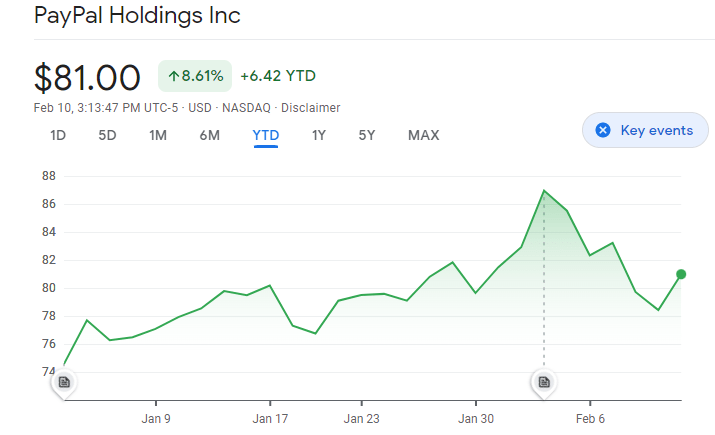
PayPal is carving out gains today following its earnings beat and fairly encouraging outlook in Q4. There was some uneasiness heading into PYPL’s report, illuminated by the stock slipping roughly 10% from February 2nd highs after some of its competition and partners, like GOOGLE, Amazon, andAffirm, delivered concerning quarterly reports. Although there were still a few areas of concern within PYPL’s Q4 results, the company dished out confidence-inspiring numbers for the most part, and CEO Daniel Schulman, who announced his retirement within the next year, carried an optimistic tone throughout the call.
PYPL topped its Q4 adjusted EPS expectations of $1.18-1.20, expanding its bottom line 11.7% to $1.24 while growing revs in line with its forecast, registering 6.7% growth to $7.38 bln. Management detailed how the company was on track to surpass its earnings forecast and grow revs in line with previous projections in early December, so investors had likely priced in these positives from Q4.
Total Payment Volume (TPV) climbed 5% yr/yr on a spot basis and 9% excluding currency fluctuations, edging past PYPL’s prior targets.
However, net new actives (NNAs) of 2.9 mln were flat sequentially, missing PYPL’s 3-4 mln goal.
Perhaps more notable, PYPL’s non-GAAP operating margins expanded for the first time since 1Q21 in Q4, adding 115 bps yr/yr to 22.9%, marking a return to profitable growth.
Identifying cost savings has been a top priority for PYPL in recent months. Recall PYPL’s decision to trim its global workforce by around 7% late last month. PYPL also noted that it discovered an incremental $600 mln of cost savings on top of the already announced $1.3 bln. Outgoing CEO Daniel Schulman stated that the organization is confident its cost structure will enable ongoing investments in high-conviction growth initiatives while helping expand margins.
Mr. Schulman added that discretionary spending will likely remain under pressure throughout the year, while global e-commerce growth should just squeak into positive territory. Still, the company is also seeing disinflationary signs, which should result in an uptick in spending. Encouragingly, management commented that Q1 is already off to a much stronger start than anticipated, with branded checkout volumes accelerating sequentially.
As a result, PYPL expects Q1 revs to expand by around 7.5% on a spot basis and 9% excluding FX impacts yr/yr, and earnings of $1.08-1.10, topping consensus.
However, due to heightened uncertainty, PYPL is still not providing full-year revenue guidance. Still, its earnings forecast of $4.87 soared past analyst expectations. PYPL noted that this guidance assumes sales growth in the mid-single-digits on a currency-neutral basis. It also does not expect total active accounts to grow this year.
Overall, PYPL rang up a decent quarter, especially after some nerve-racking reports by a few of its peers. As it is well-known and likely priced in by now, FY23 will probably not be smooth sailing. However, PYPL is conducting the right moves through cost-cutting measures and streamlining operations, which will position it nicely to step on the gas once e-commerce growth reaccelerates.
Implementing the 80/20 rule to your monthly income, you would have to calculate 20% of your net income and automatically allocate that amount to your savings account or debt repayment first. The remaining 80%, distribute it towards your necessary expenses and discretionary spending throughout the month; essentially, “paying yourself first” by prioritizing savings before other expenditures.
Key steps:
Calculate your net income: Determine your total income after taxes are deducted.
Set aside 20%: Calculate 20% of your net income.
Prioritize savings: Immediately allocate this 20% to your savings account, retirement fund, or debt repayment.
Manage the remaining 80%: Divide the remaining 80% of your income into categories like paying yourself first, housing, food, transportation, and discretionary spending.
Project Management:
The 80-20 rule is a principle that states 80% of all outcomes are derived from 20% of causes. It’s used to determine the factors (typically, in a business situation) that are most responsible for success and then focus on them to improve results.
What is the 80/20 rule in Agile?
One of the core principles of Agile development is the Pareto Principle. It basically says 80% of the impact can be generated by focusing on 20% of the problems. Rapidly iterate on the set of problems by focusing on solving only the 20% that provide 80% impact each iteration quickly, faster and faster every time.
How the Pareto Principle Can Help You
There are many ways in which you can put the Pareto principle to good use. Here’s a couple of ideas:
Planning Your Day
Since 20% of your effort amounts to 80% of the effect of your work, you should consider which activities comprise the vital few you need to focus on. To maximize your efficiency, you must identify them and work on them first. Mind you, though, you should not neglect the other tasks. Move on to doing them once you clear the big ones.
Delegating
As an executive or manager, you may feel that time isn’t exactly on your side—this is when delegating comes in handy. However, it may be a bit of a problem to decide which things you should do yourself and which ones could be handed over to your team. Not if you know the 80/20 rule. Focus on the vital 20% and delegate the rest.
Risk Assessment
How to monitor risks? Once you realize that 20% of risks can cause 80% of setbacks, you’ll know that to minimize any possible damage you must identify and closely monitor the 20%. The rest needs to be monitored too, but the relative damage it can cause is much less serious.
Sales and Marketing
If 80% of your income comes from 20% of your customers, optimize your products, services, and advertising for the 20%. Even if not everyone ends up happy about your choices, the bottom line will be in your favor.
Knowing that 20% of your posts generate 80% of your traffic, identify which types of posts perform best. Then, design a content marketing strategy that incorporates more similar posts.
“Focusing on a narrow set of the most impactful changes that can be made in your personal of professional life can bring about great improvement but also highlight the concentrated risk that exists with any changes in these decisions. In other words, changing 20% of your life or work represents a high risk/high reward scenario. If handled well, it can lead to disproportionate improvements, while handled poorly, it can result in outsized detrimental impact.
In my business environment, I attempt to isolate central touchpoints for all other areas of my work responsibilities. From there, I seek ways to automate or improve those processes in the hopes of benefits cascading throughout my work. However, because of the centrality of these activities, I need to be extremely careful when implementing changes as they can lead to widespread problems.”
80/20 Rule in Marketing and Business
One of the most common contexts for the 80/20 rule is in the marketing and sales activities of companies. While it’s often repeated that 80% of any company’s profit is generated by 20% of its customers, the same proportions could extend to other areas of business activity, for example:
80% of complaints come from 20% of customers.
80% of profits come from 20% of the company’s effort.
80% of sales come from 20% of products or services.
80% of sales are made by 20% of sellers.
80% of clients come from 20% of marketing activities.
What does this mean in practice?
To maximize their efficiency businesses should focus on the vital 20% of activity.
So—in this case, the Pareto principle becomes the Pareto methodology. And the first step to implementing it is to identify which activities comprise the vital 20%.
How to use the 80/20 rule to manage time effectively?
When applied to work, it means that approximately 20 percent of your efforts produce 80 percent of the results. Learning to recognize and then focus on that 20 percent is the key to making the most effective use of your time.
Explaining the 80-20 Rule with the Pareto Distribution
While not as well-known as the bell-shaped Normal (Gaussian) distribution, the Pareto distribution is a powerful tool for modeling a variety of real-life phenomena. It is named after the Italian economist Vilfredo Pareto (1848-1923), who developed the distribution in the 1890s as a way to describe the allocation of wealth in society. He famously observed that 80% of society’s wealth was controlled by 20% of its population, a concept now known as the “Pareto Principle” or the “80-20 Rule”.
The Pareto distribution is a power-law probability distribution, and has only two parameters to describe the distribution: α (“alpha”) and Xm. The α value is the shape parameter of the distribution, which determines how distribution is sloped (see Figure 1). The Xm parameter is the scale parameter, which represents the minimum possible value for the distribution and helps to determine the distribution’s spread. The probability density function is given by the following formula:
When we plot this function across a range of x values, we see that the distribution slopes downward as x increases. This means that the majority of the distribution’s density is concentrated near Xm on the left-hand side, with only a small proportion of the density as we move to the right. For reference, the “80-20 Rule” is represented by a distribution with alpha equal to approximately 1.16.
Figure 1: Pareto Distribution (various alpha)
Pareto in the Real World
The Pareto distribution has major implications in our society. Consider its original use case, describing the distribution of wealth across individuals in a society. The vast majority of the world’s citizens are clustered at a low level of wealth, while a small percentage of the population controls the vast majority of all wealth. Policymakers may not realize that wealth is distributed according to a Pareto distribution rather than a normal distribution, and this gap in understanding could lead to suboptimal policy decisions in countries around the world.
Perhaps equally profound is the ability to model productivity according to a Pareto distribution (while productivity and wealth are both distributed in the same manner, their correlation at the level of individuals is a matter of dispute and varies by context). In most professions it is hard to precisely quantify a worker’s productivity, but Major League Baseball (MLB) teams are experts in exactly this exercise. Using the Wins Above Replacement (WAR) metric as an estimate of a player’s value, we can see that MLB players are able to produce wins for their team in a Pareto-distributed fashion. It is amazing that even among the best 1,500 baseball players in the world, they are still distributed in this extreme way.
Figure 2: Distribution of WAR, 2021 MLB Players
There is anecdotal evidence of the Pareto Principle in other professions, for example it is commonly noted that it seems like a small number of software engineers are responsible for the majority of important code written at a firm. There are other cases of Pareto-distributed instances: the size of cities, value of oil wells, popularity of songs and videogames, size of insurance claims, and much more. By better understanding the underlying distribution of the phenomena around us, we can build better models and make more intelligent decisions. The Pareto distribution is just one option for building this understanding, and it is a powerful tool.





































 Kgoo Episode 59





 SVENFLY